
The Venue Pulse
The monthly briefing for venue & event leaders. Benchmarks, AI trends, and operational wins from 4,000+ venues.
The Inquiry That Should Have Been First
At 8:15 on a Monday, a convention center sales manager opens a queue of 63 weekend inquiries, and the team works it the way most teams do: oldest first. The morning goes to wedding receptions asking about Saturdays that are already held. Inquiry #41 is a 1,200-person association meeting looking at a shoulder-season week, with three days of catering and a full AV package, and nobody opens it until Thursday. By then, the planner has two proposals from other cities. AI lead scoring exists to fix that order of operations, but most scoring advice is written for software companies and rates the buyer while ignoring the date, the space, and the full event value. This guide covers how to build a venue lead score, turn it into priorities your team can work on, and prove it predicts bookings.
Key Takeaways
- A venue lead score has to rate the date and the space as well as the buyer, because the same inquiry is worth more in a soft week than on a sold-out Saturday.
- Total-event revenue, including catering, AV, and services, predicts a lead’s value better than the room rental line.
- Scores only change behavior when they become tiers, response targets, and routing that respects each rep’s workload.
- Back-test any scoring model against last season’s inquiries before trusting it, then recalibrate every quarter.
- Reps act on scores they can see the reasons behind and ignore black-box numbers.
What Is AI Lead Scoring?
AI lead scoring ranks incoming inquiries by how likely they are to book and how much they’re worth, using rules, historical outcomes, or both, so reps work the best opportunities first. There are three ways to build it. Rules-based scoring adds and subtracts points for criteria you choose, such as headcount or event type; it’s transparent, but only as smart as whoever wrote the rules. Predictive scoring trains a model on past inquiries and outcomes to find patterns nobody wrote down, though it needs clean history and can be hard to explain. Hybrid scoring, where most venue teams land, lets the business set the rules while AI fills gaps, spots patterns, and explains each result. It also helps to separate two jobs that often get lumped together. AI lead qualification pulls the facts out of an inquiry (date, headcount, budget, event type, flexibility) and checks whether you can host it at all. Scoring then ranks the qualified leads against each other. Using AI for lead qualification without a scoring layer still leaves reps sorting by gut, which is why both usually sit inside broader venue sales automation.
Why Generic Lead Scoring Software Misreads Venue Demand
Most lead scoring software was designed to score the buyer, and venues sell something different. In B2B software, a lead’s value comes from who they are: job title, company size, industry, and how many pricing pages they’ve visited. The product is unlimited, so any qualified buyer is worth chasing.
A venue’s inventory is finite and perishable. A ballroom on a Saturday in October can only be sold once, and a Tuesday in January that goes unsold is gone for good. That changes the math. A 300-person corporate dinner is a strong lead for an open midweek date and a weak one for a Saturday already carrying a first hold from a higher-value convention. An engagement score built on email opens can’t see any of that. Put simply, the same inquiry deserves a different score depending on when it wants to happen and what else wants the space. That’s why scoring works best close to the calendar and account history, the same shift driving AI CRM for event management.
The Four Signals a Venue Lead Score Should Weigh
A useful venue score blends four signals: fit, date value, total-event revenue, and readiness. Each one answers a question a rep would otherwise answer by hand.
Fit: Event Type, Headcount, and Space
Fit asks whether you can host this event well. Score event type against your strengths, headcount against the spaces that suit it, and setup needs (rigging, load-in, breakout count) against what your rooms support. An inquiry that needs 14 breakouts at a venue with eight belongs in a referral or a polite decline, and AI lead qualification should catch that before it ever gets a score.
Date Value: Peak, Shoulder, and Displacement
Date value asks what this booking is worth on the calendar, not only in the contract. Rank dates by demand (peak, shoulder, soft), give credit for flexibility, since a planner open to three different weeks gives you options, and check what’s already holding the space. If a lower-value event would take a date you’d likely fill at a higher rate, the score should reflect that displacement risk. That only works when scoring reads holds and setup windows from your live event calendar management rather than a spreadsheet someone updated last week.
Total-Event Revenue, Not Just Room Rent
Revenue asks what the whole event is worth once you’ve paid to deliver it. Room rental is often the smallest line. Estimate catering, AV, labor, and services from the inquiry and from comparable past events, then account for cost to serve. A multi-day show with heavy load-in, overnight security, and overtime crews can bring in more top-line revenue and less margin than a smaller event that runs cleanly, where you can score on projected margin rather than gross.
Readiness and Lead Source Quality
Readiness asks whether this planner is ready to buy. Strong signals include a decision date, a defined budget, a complete RFP, a site-visit request, and a returning client. Source matters too. Inquiries arrive by web form, email, phone, and third-party sourcing marketplaces, and each channel converts differently at most venues. Track inquiry-to-contract rate by source and let the score learn from it, rather than treating an RFP sent to 20 venues the same as a direct call from a past client. Detailed event RFP responses are where these signals pay off most, because they take the most rep time to answer well.
Here’s an illustrative starting point. Treat the weights as a hypothesis to test against your own history, not a benchmark.
Those weights will move once you test them, which is exactly what the scoring should do as your data improves.
How Scoring Changes by Venue Type
The four signals hold everywhere, but the weights shift with what you sell. Convention centers and conference centers lean on date value and total-event revenue, because a single citywide booking 18 months out shapes the whole calendar and catering can outweigh rent. Stadiums and arenas score non-event-day inquiries around the event schedule, so a corporate party is only valuable on dates the bowl and suites aren’t already committed. Performing arts centers protect performance dates and score rentals on dark nights and the technical demands of each show. Universities balance outside revenue against academic priorities, so fit includes whether a request clashes with commencement or exams. Hotels weigh room blocks alongside function space. Wedding venues, with high volume and quick decisions, lean harder on readiness. Once you know which pattern you’re in, most of the weighting decisions make themselves.
Turning Scores Into Priority Tiers and Response Targets
A score only matters once it changes what a rep does next, and most teams get there with three tiers.
Tier 1, act now: High fit, high value, and ready to buy. These go straight to a senior rep with the fastest response target your team can reliably hit.
Tier 2, same day: Good fit with a missing piece, such as an unconfirmed budget or open dates. Reps follow up with specific qualifying questions rather than a generic brochure.
Tier 3, automated or templated: Poor fit, displacing dates, or very low value. A clear, friendly templated reply that offers alternatives, like other dates or a partner venue, protects the relationship without eating rep time.
Set the actual response targets from your own data. The right number depends on how fast your market moves and how many reps you have, and a target nobody hits does more damage than a modest one the team owns. That said, tiers break down quickly if routing ignores who’s available to work them.
Route by Team Capacity, Not Just Score
Routing by score alone falls apart the moment ten Tier 1 leads land in the same afternoon. Assign by score and capacity: who owns the account, who has room this week, and who has run that event type before. When the queue spikes after a trade show or a marketing push, rebalance the load instead of letting your best rep’s inbox become the bottleneck.
Keep Stalled Leads From Going Dark
Leads that go quiet should be rescored, not forgotten. Set a follow-up cadence by tier, then rescore when something changes: the planner opens the proposal, the requested date gets more competitive, or a competing hold drops. A Tier 2 lead from six weeks ago can become the most valuable inquiry in the queue the day another group releases its dates.
How to Prove Your Lead Score Predicts Bookings
Here’s the thing: a score nobody has tested is an opinion with a number attached. Before you trust a model, back-test it. Pull last season’s inquiries, score them with today’s rules, and compare the results with what actually booked. If your Tier 1 leads didn’t convert at a clearly higher rate than Tier 3, the weights are wrong. Study the misses too. Contracts that scored low and high scorers that went nowhere usually point to one signal that’s over- or underweighted. Rebalance, rescore, and check again. After go-live, review a sample of scores with reps every month, since their overrides show what the model can’t see, and recalibrate every quarter against inquiry-to-contract rate, average contract value, and time to first response by tier. Tie those results to the key performance indicators for event management your leadership already reviews, so the scoring model is judged on revenue rather than activity.
What to Look for in AI Lead Scoring Tools
The best lead scoring software for a venue is the one your reps will believe, and belief comes from a few specific capabilities. Ask for explainable scores, with the reasons behind every number visible to the rep. Make sure the rules are yours to configure, because no vendor knows your peak dates or your catering minimums. Check that scoring reads the live calendar and account history rather than a nightly export. It should capture inquiries from every channel you use, including email attachments, and recognize returning clients instead of creating duplicates. Confirm a rep can override any score and that the override is logged, and get the data policy in writing, including whether your inquiries train anyone else’s model. Before demos start, agree internally on the problem you’re solving using a five-step process for venue technology decisions, and ask how each tool connects to your current stack, since event software integrations decide whether the score sees the full picture.
How Momentus Approaches Lead Scoring for Venue Sales
Every section above lands in the same place: a venue lead score is only as good as what it can see, from the calendar and rate rules to the full event value and the history with that client. What we consistently hear from venue sales leaders is that the problem was never a shortage of inquiries. It’s the hours reps lose triaging them while the best opportunity sits under duplicates and tire-kickers.
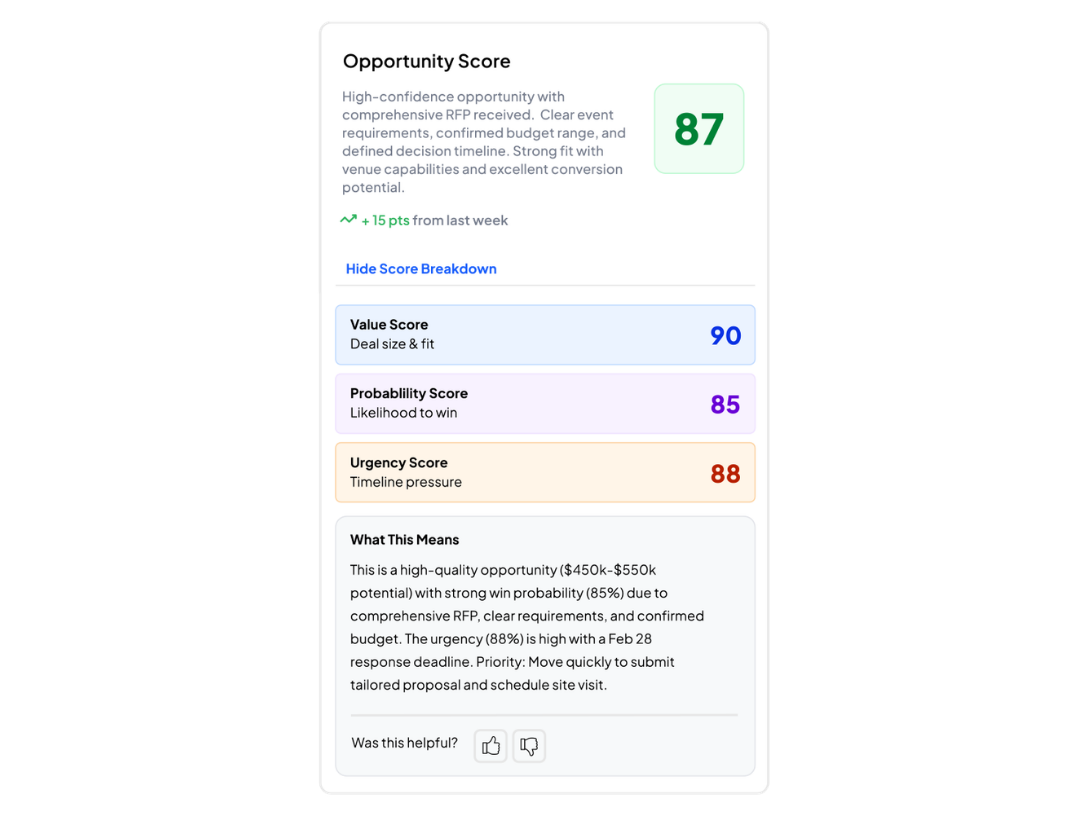
That’s why lead scoring in MAX for Sales, the first product in MomentusMAX, runs inside Momentus rather than beside it. It captures inquiries from web forms, email, and attachments, recognizes returning clients instead of duplicating them, and ranks every lead using your configurable business rules, while AI explains exactly why each score was given. Deal analysis puts the communication timeline, past event data, and revenue history in front of the rep, along with a suggested next step. Because scoring sits on the same platform as the calendar, it works alongside competing-hold comparisons by projected revenue. Every recommendation is reviewable before it reaches a client, and customer data isn’t used to train public models. Convention center sales teams can see how it fits their workflow, and the Momentus Trust Center holds security documentation.
Founded in 1985, Momentus supports more than 90,000 users in more than 57 countries. Event management software should tell your team which inquiry to answer first, and why. Venue management software built the right way pairs intuitive technology with data-driven solutions, giving your team a clear view of the past, present, and future of every space, so the best lead in the queue is the first one a rep opens.
Want to see how artificial intelligence is transforming the industry? Register for our upcoming webinar, What AI Actually Means for Events, to learn more.
See what your venue is missing
Explore the platform trusted by SoFi Stadium and the Apollo Theater to fill more dates, streamline operations and maximize revenue