
Le pouls du lieu
Le bulletin mensuel destiné aux responsables de sites et d'événements. Indicateurs de référence, tendances en matière d'IA et bonnes pratiques opérationnelles issues de plus de 4 000 sites.
It's Monday morning, and a convention center sales team opens the inbox to 14 new RFPs: a 9,000-attendee association convention, a regional trade show that needs two exhibit halls, and a corporate meeting asking for breakouts on dates already sitting on a tentative hold. Every one of them has to be checked against the master calendar, priced across space, F&B, AV, and labor, and answered before a competing city gets there first. An event RFP tool is the software that captures, qualifies, and answers those requests in one place, instead of across a dozen inboxes and spreadsheets. Speed matters here because citywide and association business usually comes through CVBs and planner platforms that send the same RFP to several destinations at once, so a slow or incomplete response can lose the deal before anyone on your team ever talks to the planner. This article covers how planner-side and venue-side RFP tools differ, which features matter, what a convention center RFP workflow should include, how to evaluate your options, and which metrics show the process is working.
Planner Tools vs. Venue Tools: Two Sides of the Event RFP
An event RFP (request for proposal) is a document a planner sends to venues and suppliers listing dates, attendance, space needs, F&B, AV, and budget so they can submit bids. The software that manages that exchange does one of two jobs: it either sends and compares RFPs on the planner side, or it captures and answers them on the venue side. Planner-side tools are built for sourcing. They help planners find venues and vendors, build event specs or agendas (some with AI agenda builders), send one RFP to dozens of properties at once, and compare bids side by side instead of in a spreadsheet. The larger supplier networks list hundreds of thousands of hotels and venues worldwide, and many add historical spend analytics, approval workflows, audit trails, and post-event vendor ratings on budget and quality.
Venue-side tools work the other end of the exchange. Their job is to capture inbound requests, score and route leads, and cut response time, usually through 24/7 RFP forms embedded on the venue's website, automated upsells during the request (extra hours, catering upgrades, AV), automatic lead-fit scoring, and auto-assignment of meeting space. Some also run marketplaces where venues can bid on open RFPs they were never sent in the first place. Both sides are moving toward AI-assisted sourcing, automated bid comparison, and side-by-side proposal tracking. Event management software has picked up many of these capabilities too, which brings venues to the question that actually decides revenue: what happens after the RFP arrives?
Core Features to Look for in an Event RFP Tool
Whichever side you're on, a few capabilities separate a real RFP tool from a shared inbox with templates.
- Centralized RFP intake: All requests, whether they come from website forms, email, CVB leads, or marketplace RFPs, land in one queue with standard fields for dates, attendance, space, and budget. Nobody has to re-type an RFP into the booking system.
- Lead scoring and routing: Each request is scored on fit (attendance vs. capacity, dates vs. open inventory, budget vs. minimums) and routed automatically to the right sales manager by event type, market segment, or territory.
- Live availability checks: The tool reads your real-time master events calendar, including tentative holds and move-in and move-out days, before a rep commits to dates.
- AI-assisted proposal drafting: A draft event proposal gets built from the venue's own space, rate, and package data, and a rep reviews it before it goes out. Think of it as the venue-side version of the AI drafting planner tools already offer.
- Side-by-side tracking and pipeline visibility: Every open RFP, proposal, and hold shows up in one view with its stage, value, and expiration date, so leaders can see the pipeline without asking anyone for a status spreadsheet.
- Automated upsells and packages: F&B upgrades, AV packages, and extended hours are offered during the request and proposal stage, which raises revenue per event without adding sales effort.
- Audit trail and approvals: Every pricing change, discount, and approval gets logged. That matters a lot for public venues that answer to boards and convention authorities.
Why Convention Centers Outgrow Standalone RFP Tools
Most venue-side RFP tools were built for hotels, where the job is mostly done once a room block and meeting space are quoted. Convention centers sell something very different: multi-day, multi-hall events with move-in and move-out days, exhibitor services, rigging, labor, and floor plans that have to keep fire lanes clear. A standalone RFP inbox can capture a trade show request just fine. But if it doesn't connect to the master calendar, the floor plan, and the contracting system, your sales team still re-keys everything the moment the deal turns real. That's where the errors and bad data come from.
Here's the thing: the problems a bolt-on tool creates are the same ones convention center teams already fight every week. Disconnected systems, no standardized workflows, and little real-time visibility into forecasting all come right back the moment you add another silo. For a convention center, RFP management works best as the front door of the venue platform, flowing into booking, proposals, contracts, event orders, and reporting without a handoff. That's the case for purpose-built convention center event software and for venue automation that carries data forward instead of asking people to copy it.
What a Convention Center RFP Workflow Should Include
A strong workflow moves an RFP from first contact to the operations handoff without anyone re-keying data. These five stages are what a convention center should expect its RFP tool or venue platform to support, and they double as a practical answer to a common buying question: what should be in a convention center event management software RFP?
1: Capture and Qualify Every Request
Requests from CVBs, planner platforms, website forms, and direct email should land in one queue with standardized fields. Qualification then checks attendance against hall and meeting room capacity, requested dates against open inventory, and the event's economic value (room nights, attendance, F&B) against your booking priorities. This step matters more than it looks, because many convention centers protect peak dates for citywide business that drives hotel room nights. A smaller request on those dates may need a thoughtful alternative rather than a quick yes.
2: Check Space and Dates Against the Live Calendar
Once a request qualifies, availability has to include move-in and move-out days, not just show days, along with any competing tentative holds and when they expire. For exhibit space, that also means checking hall configurations and floor plans that respect fire lanes and rigging points, which is where trade show floor plan software earns its keep. When two requests want the same space, revenue per available square foot (RevPASF) gives you a fair way to compare them. Put simply, the better booking is the one that earns more from the floor across the full occupancy, not the one that happened to ask first.
3: Build and Send the Proposal
With dates confirmed, the proposal should pull rental rates, F&B minimums, AV, labor, and exhibitor services from one rate structure instead of five separate spreadsheets. Branded, consistent proposals go out faster. Standard templates also mean every salesperson answers RFPs the same way, which fixes one of the most common complaints from convention center leadership: there's no standardized workflow.
4: Contract, Deposit, and Approvals
When the planner accepts, contract templates should fill in automatically with the agreed dates, space, and pricing. Deposit schedules and payments get tracked in the same system, so finance isn't chasing sales for status, and integrated venue payment solutions keep that money moving on schedule. Approval routing and an audit trail give boards and convention authorities the oversight they expect.
5: Hand Off to Operations and Report on Results
Signed business should flow into event orders, exhibitor services, and operations with no re-entry, so the details the planner shared in the RFP reach the event team intact. After the show closes, actual revenue, attendance, and room nights feed reporting on pipeline, win rate, and economic impact for city and CVB stakeholders. Exhibition management software that closes this loop turns every RFP into data you can use to forecast and defend the next booking.
How to Evaluate an Event RFP Tool or Venue Platform
If you're buying software through your own formal RFP, which is common for public convention centers, these are the criteria that separate real fit from a polished demo.
- Functional requirements, classified: List requirements across sales and CRM, booking, operations, F&B, finance, and reporting. Ask vendors to mark each one as standard, configurable, custom, third-party, or unavailable.
- Roadmap promises don't count: Score only what exists today. Anything marked "on the roadmap" gets no credit until it ships, or it gets tied to contract milestones.
- Integrations and data ownership: Confirm open APIs and integrations with ERP and accounting systems (NetSuite, for example), identity providers for SSO, and building systems. Require full data export and clear ownership terms in the contract, and review the features to look for in event management software before you write this section.
- Security and compliance: Ask for SOC 2 reporting, SSO and role-based access control, PCI compliance for payments, disaster recovery plans, and an uptime commitment (99.9% is a common benchmark). Live-event support coverage while shows are running belongs in your event risk management planning, too.
- Convention-specific modules: Look for an exhibitor portal, floor plan and diagramming tools, rigging and labor management, and RevPASF reporting. Generic hospitality platforms often lack these.
- Implementation and adoption: Pin down data migration scope, training, support SLAs, and a real change management plan for staff adoption, not just a few training sessions. Ask for typical go-live timelines from venues of similar size.
- Pricing and total cost of ownership: Require pricing in a standard 3 to 5 year TCO format so bids can be compared fairly. That should cover licenses, implementation, integrations, support, and renewal increases.
- Scripted demos and references: Give vendors real scenarios to run live, such as "a trade show requests Halls A and B, but Hall B has a tentative hold that expires Friday." Then ask for references from comparable convention centers.
Public venues should also check cooperative purchasing contract options, protest procedures, and local procurement compliance rules before the RFP goes out. Once responses come in, a weighted scorecard keeps the comparison honest. The weights below are a starting point you can adjust to your own priorities.
Metrics That Show Your RFP Process Is Working
Track these before and after a new tool goes live so the result is measured, not anecdotal.
- RFP response time: Hours from RFP receipt to a complete proposal, which is usually the first number to improve.
- RFP win rate: The share of qualified RFPs that become signed contracts, tracked by market segment.
- Pipeline value by stage: The total value of open RFPs, proposals, and tentative holds, which feeds directly into revenue forecasting.
- Space utilization: Booked days and square footage against available inventory, including dark days you've managed to fill.
- Economic impact: Attendance, hotel room nights, and estimated visitor spending from booked events, reported to the city, convention authority, or CVB.
These five are the core. A broader set of event management KPIs is worth adding once event reporting software can pull them automatically instead of someone building the report by hand every month.
Bringing RFPs, Booking, and Reporting Into One Platform With Momentus
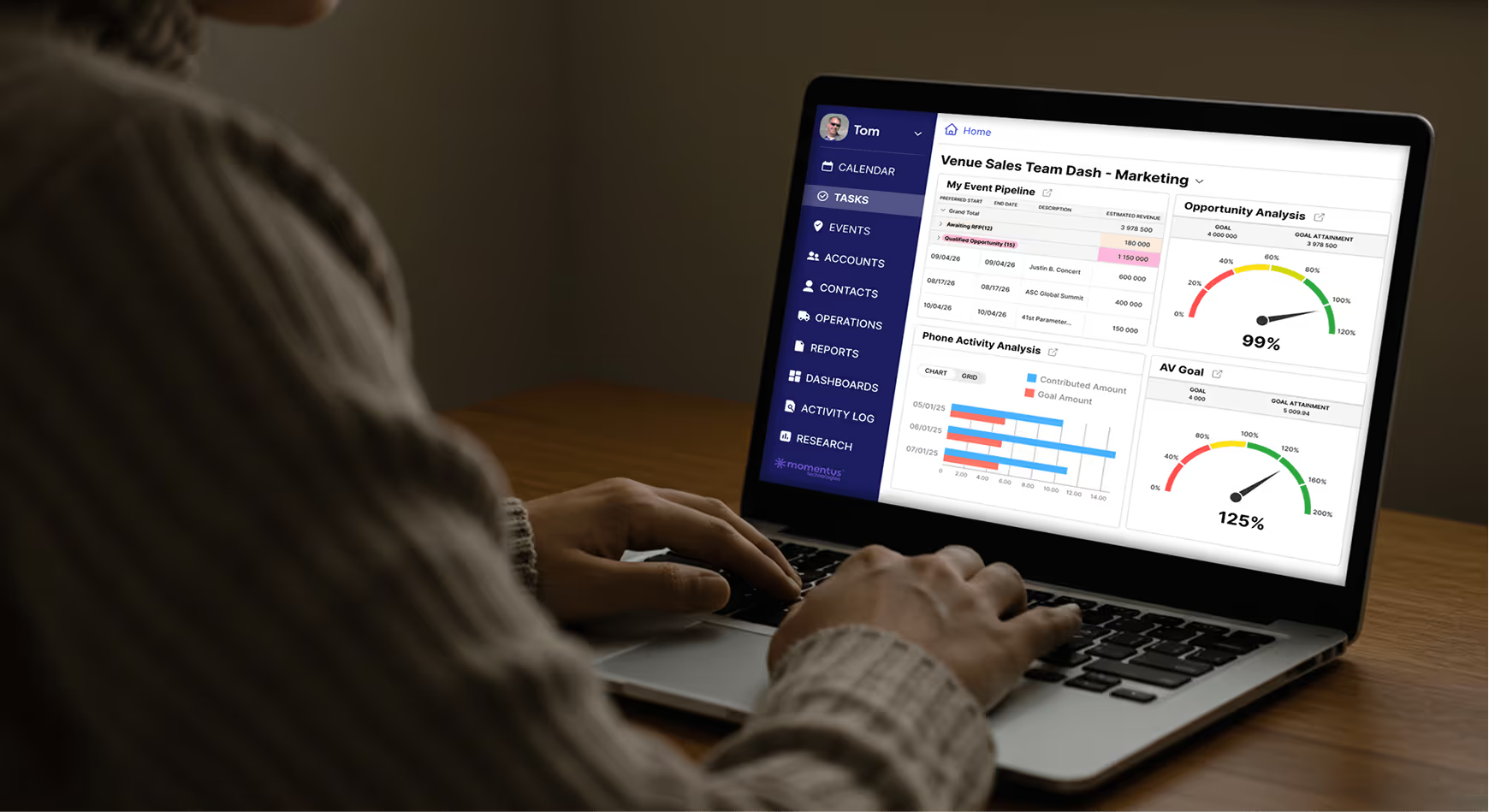
Every feature and metric above depends on one thing: the RFP has to connect to the rest of the venue's operation. When intake, calendar, proposals, contracts, and reporting live in separate tools, response times slip and the data leadership needs never comes together. Momentus Enterprise runs the full path from first inquiry to proposal, contract, event orders, and reporting in one system, including estimated room nights and economic impact for city and CVB stakeholders. MAX for Sales adds AI that captures and scores each inquiry, flags calendar conflicts including setup and teardown, and drafts the proposal with recommended packages from your own pricing rules. Your team reviews and sends. Momentus WeTrack adds risk and incident management, while open, secure integrations connect finance and other systems.
We built Momentus for venues, where one event can span multiple halls, move-in days, and exhibitor orders. Every time event details get re-keyed after the RFP, revenue has a place to slip through, and Minneapolis Convention Center reports 7% to 15% revenue growth after closing those gaps with Momentus. What we consistently hear from convention center teams is that the RFP was never the hard part; the hard part was everything that had to be re-entered after it. Founded in 1985, Momentus supports more than 90,000 users in more than 57 countries. The 2023 rebrand brought EventBooking, Priava, and Showorks together under one platform for venue and event management. Venue management software built this way lets an event RFP tool do its real job, giving your team a clear view of the past, present, and future of your business. That's how Momentus helps venues make every moment momentus.
Découvrez ce qui manque à votre établissement
Découvrez la plateforme à laquelle font confiance le SoFi Stadium et l'Apollo Theater pour remplir davantage de dates, rationaliser leurs opérations et optimiser leurs revenus